A support assistant does more than store documents. It sends questions, retrieved text and conversation history to services that process them. Each step creates a data boundary worth checking.
Sovereign RAG explores a customer-support assistant with an AWS Sydney architecture. The question is not only whether the answer is useful. It is also where the data travels, who can access it, and which controls enforce those choices.
This article follows the Sovereign RAG repository, including its Terraform and answer code. The diagrams come from that repository. The interactive examples do not call AWS.
Why data sovereignty changes the design
Data residency concerns the location of data storage and processing. Data sovereignty also concerns control over that data and the jurisdiction that applies to it. A regional deployment contributes to that goal. It does not establish every governance or compliance requirement by itself.
For RAG, the data includes source documents, embeddings, questions, retrieved passages, responses and logs. Keeping an S3 bucket in Sydney does not prove that every model request stays there. The inference path needs its own checks.
AWS documents cross-region inference as a separate routing choice. An inference profile can send a request to another destination region. A source endpoint in Sydney alone therefore does not establish a Sydney processing boundary.
Start with the complete data path
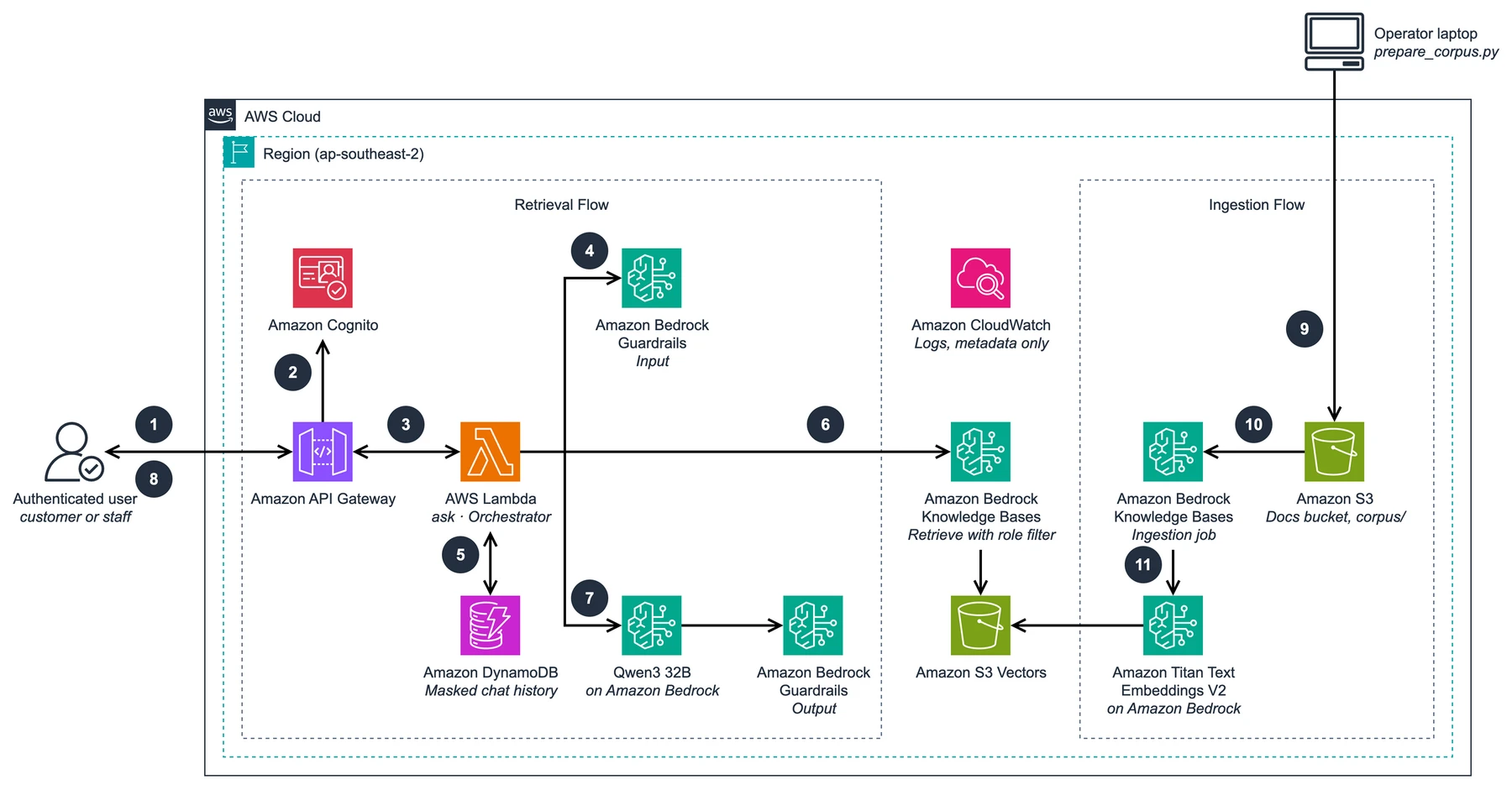
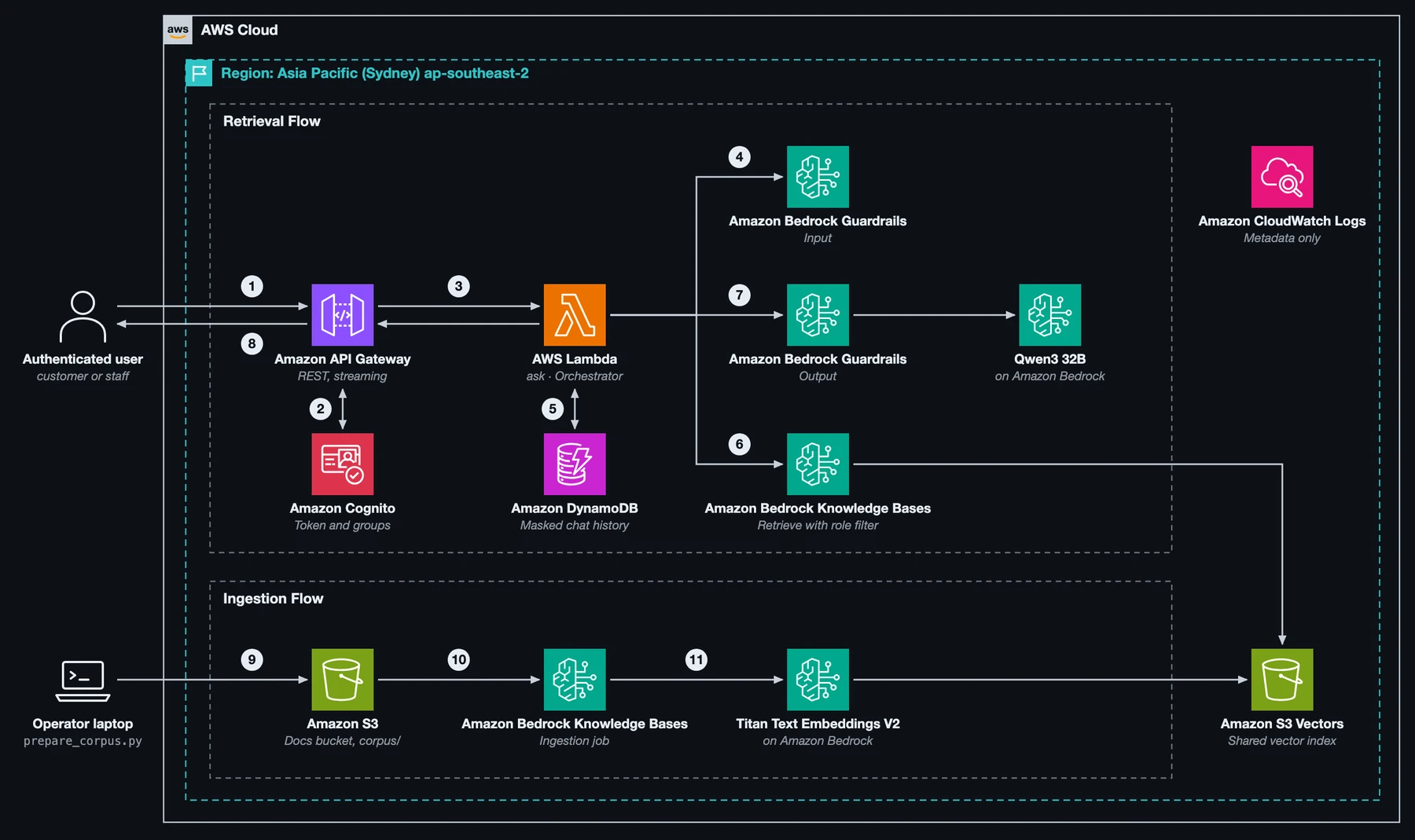
The project targets ap-southeast-2 for its cloud resources.
Its Terraform variable checks that exact region.
The AWS provider uses that variable.
The application also configures regional Bedrock clients.
The inference permissions reference the Sydney foundation-model ARN for qwen.qwen3-32b-v1:0.
The embedding permissions reference the regional Titan V2 model ARN.
Relevant IAM statements also require aws:RequestedRegion to match the configured region.
These are concrete controls in the repository, rather than a regional label on a diagram. They scope the permissions that these policies grant. They are not an organization-wide denial of every other region or proof of the deployed account's full policy state.
Inspect the regional controls
Select a layer below to inspect its control and remaining boundary. Then compare a regional model call with a hypothetical cross-region profile. The comparison explains a design decision. It does not change the actual project configuration.
Inspect the regional data boundary
Repository control
Terraform validates ap-southeast-2 and provisions the document bucket, vector index and chat table in that region.
Boundary to check
An operator's corpus preparation runs outside AWS. Backups and later copies need separate checks.
Sydney API → Sydney regional model
The source code selects a regional model and scopes its permissions to Sydney. Deployment and service-specific handling still need checks.
Ingestion: keep documents and embeddings in the regional path
The preparation script reads the sample WixQA corpus on the operator's machine. It uploads markdown and metadata to an Amazon S3 bucket. That source preparation happens outside the AWS architecture boundary.
Bedrock Knowledge Bases ingests the documents. Titan Text Embeddings V2 converts document chunks into vectors. S3 Vectors stores those vectors for similarity search.
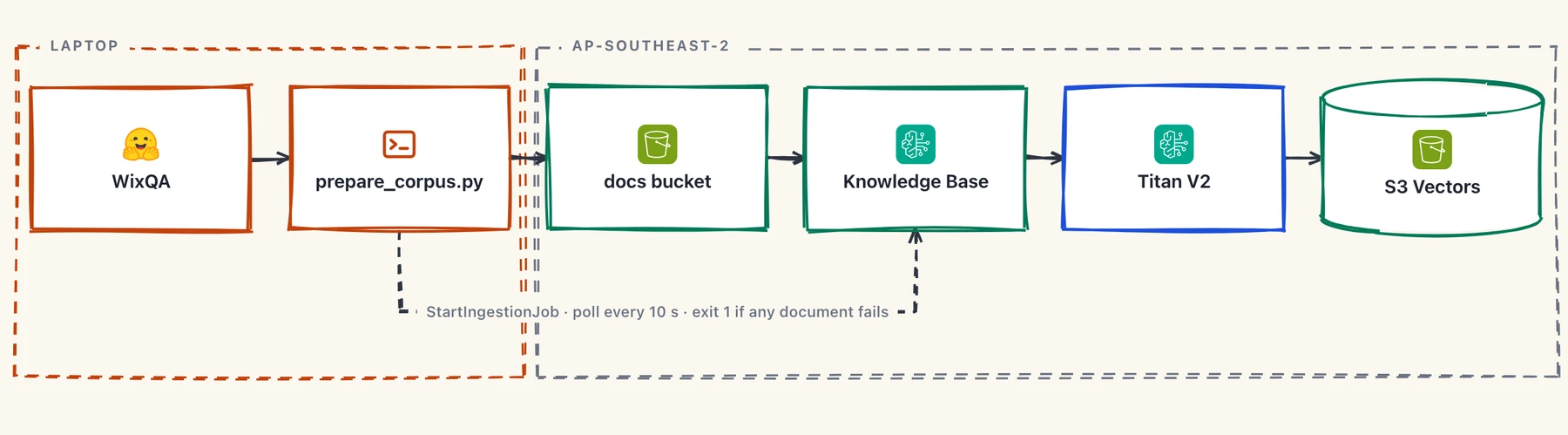
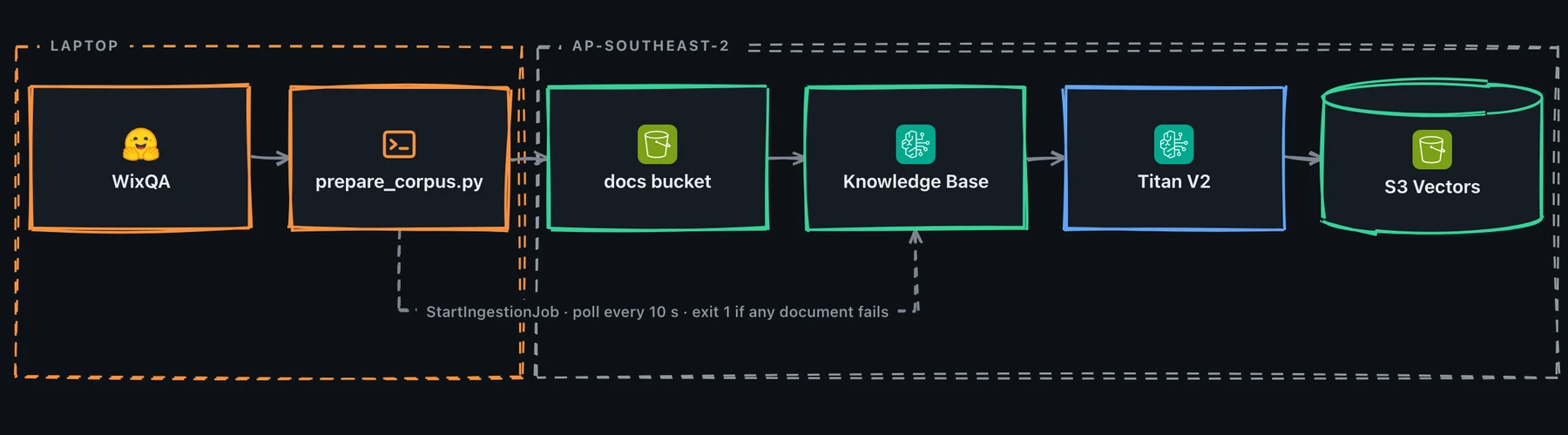
The documents bucket blocks public access and denies insecure transport. The knowledge-base role scopes document reads to the corpus path. Its embedding and vector permissions use specific resources and region conditions. Documents and vector records remain distinct assets that need access and deletion controls.
Requests: identity, retrieval and inference
Amazon Cognito supplies the caller's identity. API Gateway checks the token and requires an API key. AWS Lambda then coordinates the answer flow. The API key supplements authentication. It does not replace the Cognito identity.
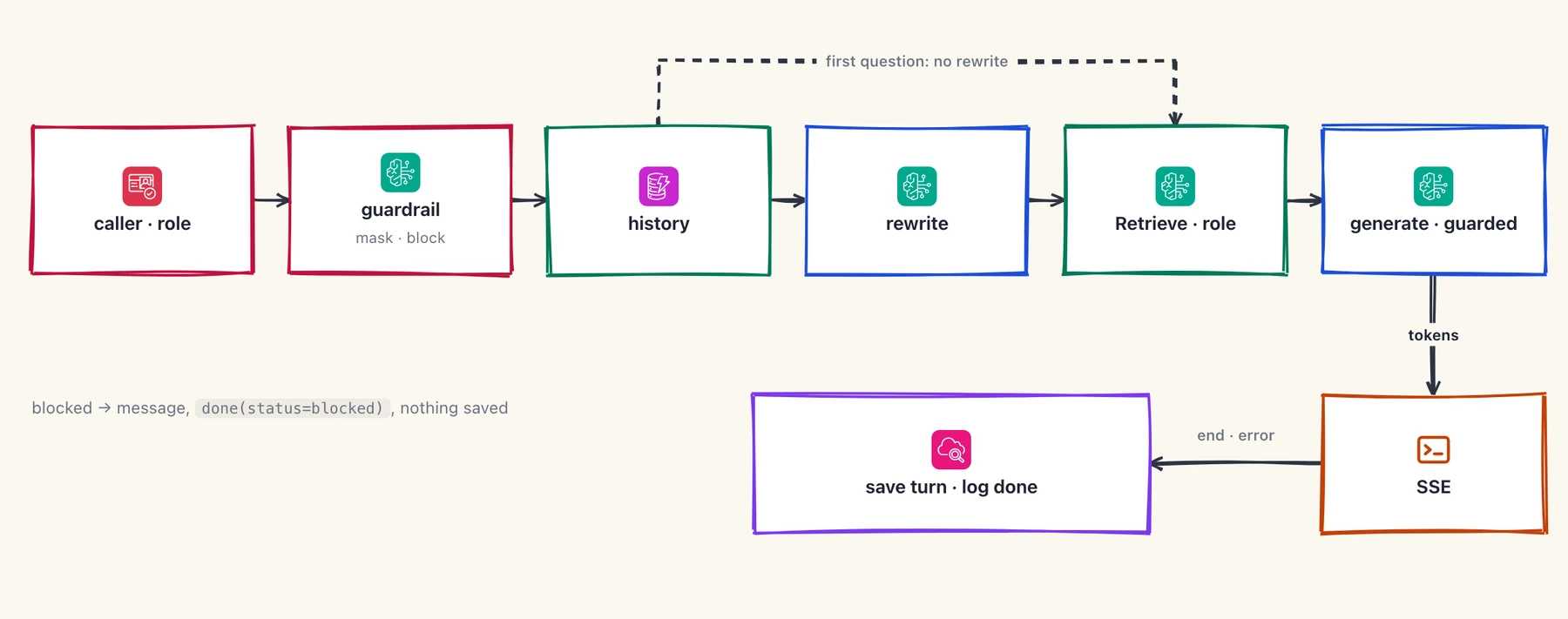
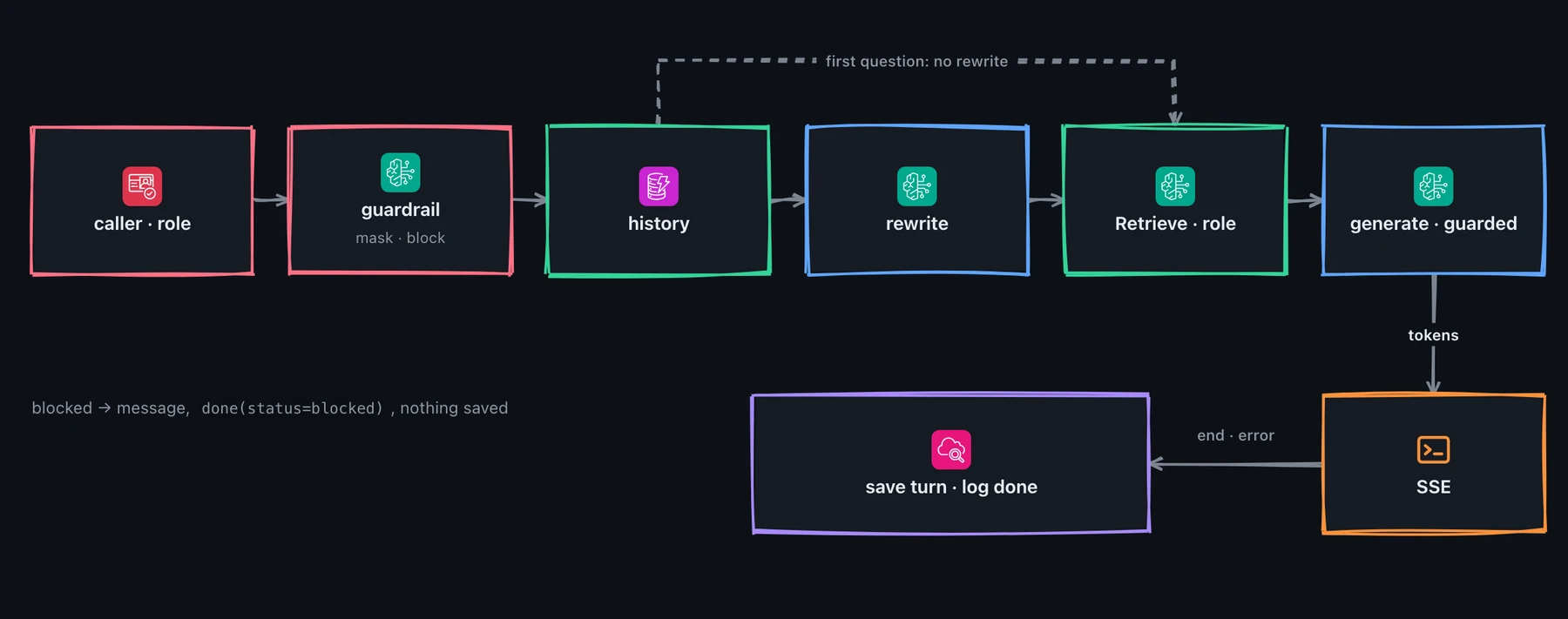
Lambda applies Bedrock Guardrails to the incoming question. It stores masked conversation turns in DynamoDB. It retrieves relevant sources with a role filter before sending them to Qwen3 32B through Bedrock. An output guardrail checks the response before storage and return.
The model request contains retrieved source text and recent completed conversation turns. These are part of the processing boundary, even when the original documents remain in S3. The runtime uses the regional Bedrock endpoint and a direct model ID, rather than a configured cross-region inference profile.
Sovereignty also needs access control
Customers can retrieve help articles.
Staff can also retrieve known issues and feature requests.
The backend reads the role from Cognito claims and sends an article_type filter with the retrieval request.
The model does not decide which role the caller holds. A prompt instruction cannot replace the backend filter. Try a known-issue question as each role below.
Explore role-based retrieval
Original question
My email is alex@example.com. How do I create a store?
After illustrative masking
My email is [EMAIL]. How do I create a store?
Inspect a request stage
Retrieve
The backend sends an article_type filter with the search query. Customers can retrieve help articles only.
- Help articlePermitted
- Known issueExcluded by role filter
- Feature requestExcluded by role filter
The documents in this example are synthetic. The widget demonstrates filtering, not an access boundary inside your browser. The repository's server code supplies the actual role-based retrieval boundary.
Logs and retention are part of the architecture
The application writes request metadata to CloudWatch, rather than logging the question and answer in its handler. Terraform sets the Lambda log group's retention to 14 days. The chat records use a 30-day expiry with DynamoDB TTL. TTL expiry does not guarantee immediate deletion at the exact expiry time.
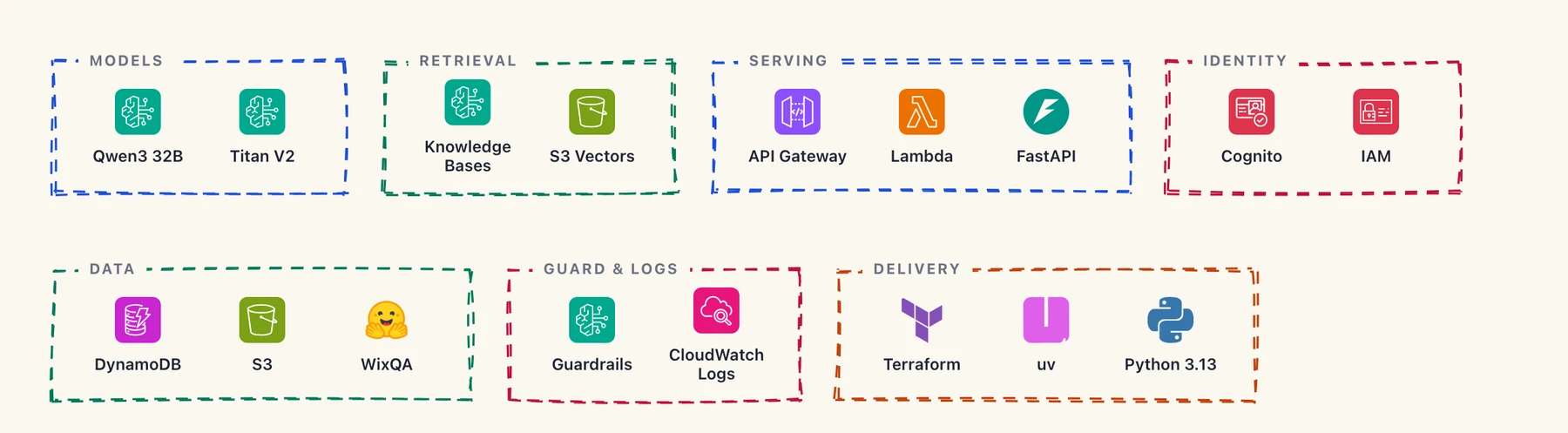
| Service | What it controls or supplies |
|---|---|
| S3 | Stores the document corpus. |
| S3 Vectors | Stores the vector index. |
| Bedrock Knowledge Bases | Ingests documents and retrieves source chunks. |
| Titan V2 | Produces embeddings for ingestion. |
| Qwen3 on Bedrock | Generates the answer from retrieved sources. |
| Bedrock Guardrails | Applies input and output content controls. |
| Cognito | Supplies authenticated identities and staff group claims. |
| API Gateway | Provides the regional request endpoint. |
| Lambda | Coordinates masking, retrieval and generation. |
| DynamoDB | Stores conversation records with expiry. |
| CloudWatch | Stores operational logs. |
| IAM | Scopes workload permissions to resources and regions. |
| Terraform | Defines the infrastructure and regional validation. |
What this architecture establishes, and what it does not
The repository defines a regional storage and inference design with resource-scoped permissions. It also defines identity, retrieval filtering, masking and retention settings. These controls make the data path explicit and reviewable.
The API remains reachable over the network. This is not a fully private VPC-only system. Operators must also check client machines, backups, account permissions, encryption requirements and service-specific data handling. Changing models or inference profiles requires another review of processing destinations.
AWS's data-protection guidance describes the shared responsibility for these choices. The architecture does not certify compliance, or prove that every personal detail receives masking. Source citations also need separate checks for whether they support the generated claims.
Inspect the region validation, model and API permissions, ingestion permissions, and storage controls. For a different boundary, read Wayfinder's A2A and long-term memory design.